Artificial Intelligence (AI)
Artificial Intelligence (AI) is a broad field of computer science focused on creating systems that can perform tasks that typically require human intelligence. This includes abilities like learning, reasoning, problem-solving, and understanding language.
The key ingredients to achieve modern AI are data, algorithms, and computation (processing power).
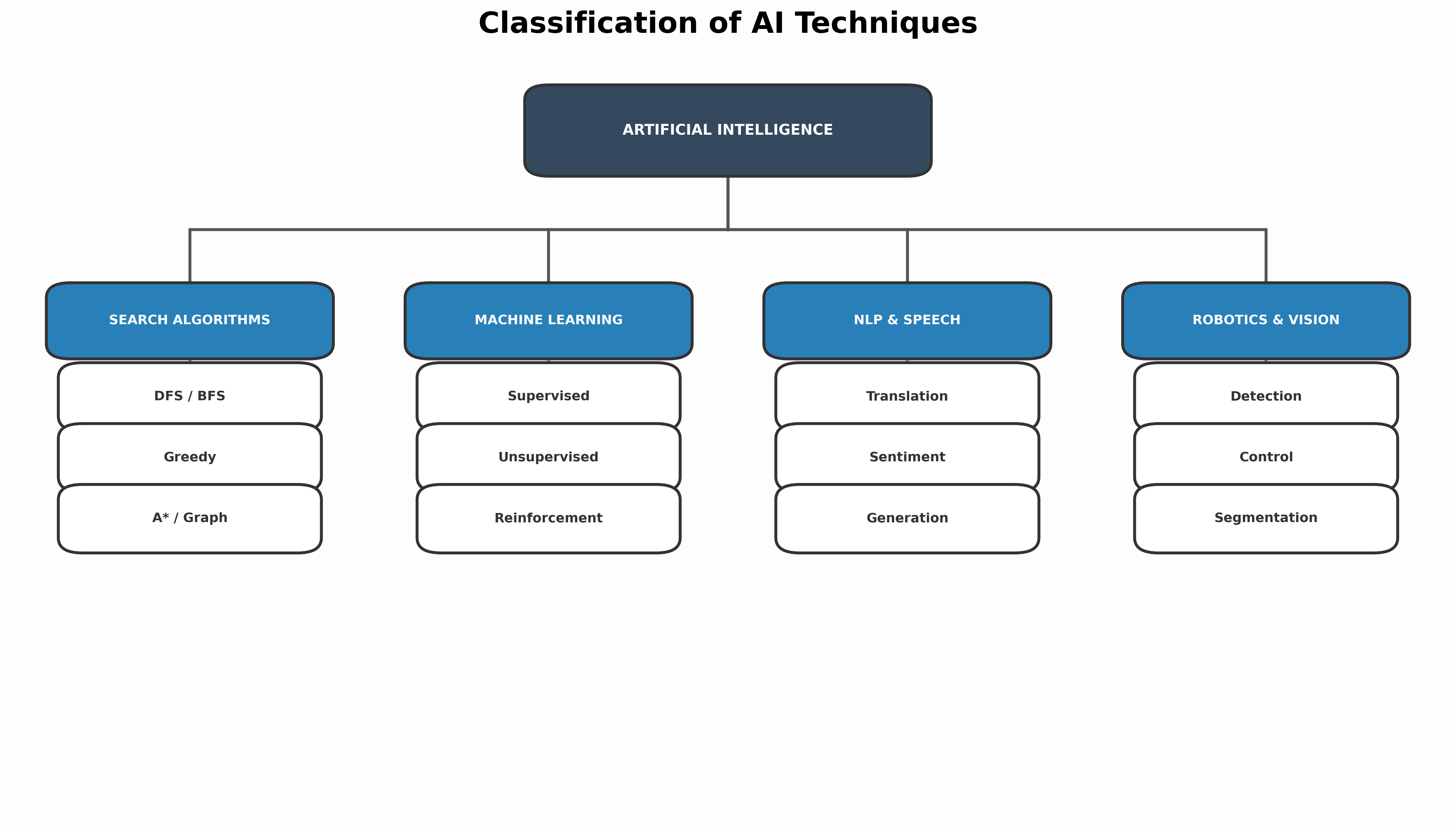
- Search algorithms like Depth-First Search, Breadth-First Search, Greedy Search, and Graph Search all fall under the umbrella of AI. Google Maps is a classic example of using such algorithms.
Terms and Definitions
Many terms are used to define the various branches and techniques in AI. Although there are no official standards for classifying these terms, here is a commonly accepted set of definitions.
Data Mining (DM)
Data mining is a broad field at the intersection of many disciplines.
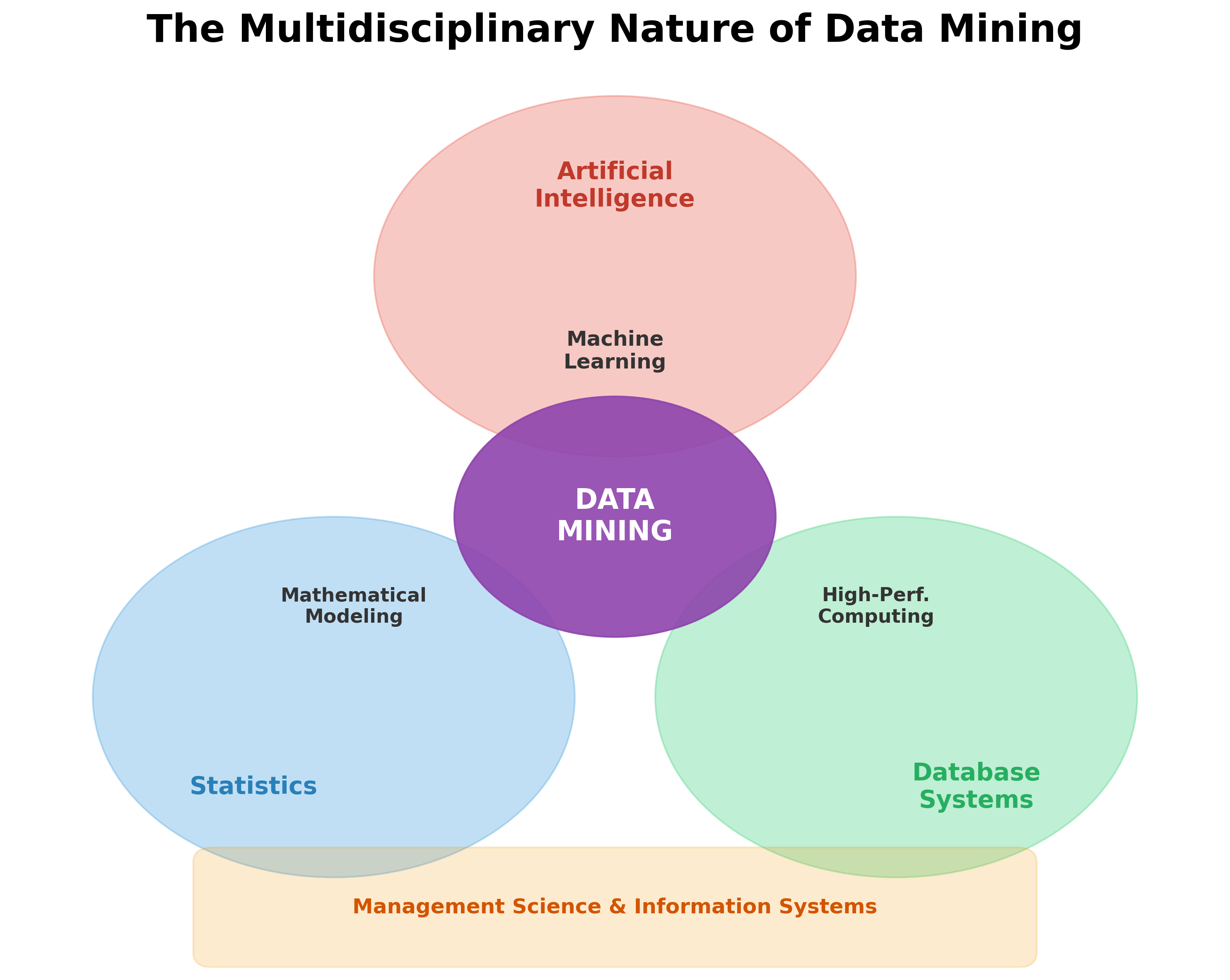
As shown in the diagram, Data Mining is a multidisciplinary field that thrives at the confluence of several key domains:
- The Three Pillars: It draws its mathematical foundation from Statistics, its algorithmic power from Artificial Intelligence, and its data management capabilities from Database Systems.
- Intersections:
- Machine Learning acts as the primary engine for pattern discovery within the AI domain.
- Mathematical Modeling provides the formal framework to represent discovered relationships.
- High-Performance Computing ensures that these techniques can scale to the massive datasets typical of the modern era.
- Foundational Context: In practice, Data Mining is often grounded in Management Science, as it is frequently used to solve complex business problems and drive data-informed decision-making.
It involves knowledge discovery using a sophisticated blend of techniques from traditional statistics, artificial intelligence, and computer graphics.
The discovery process can be broadly classified as:
- Exploratory – analyze data for new or unexpected relationships
- Explanatory – explain observed events or conditions
- Confirmatory – confirm hypotheses
Traditional data mining works with structured data, such as numerical and categorical data, that you would typically find in relational databases. But with the advent of the web and social media, there is a huge amount of unstructured data in the form of text entries in blogs, emails, and tweets. This is just as important as, and actually much higher in volume than, structured data. Web text mining is an increasingly important part of data mining.
Machine Learning (ML)
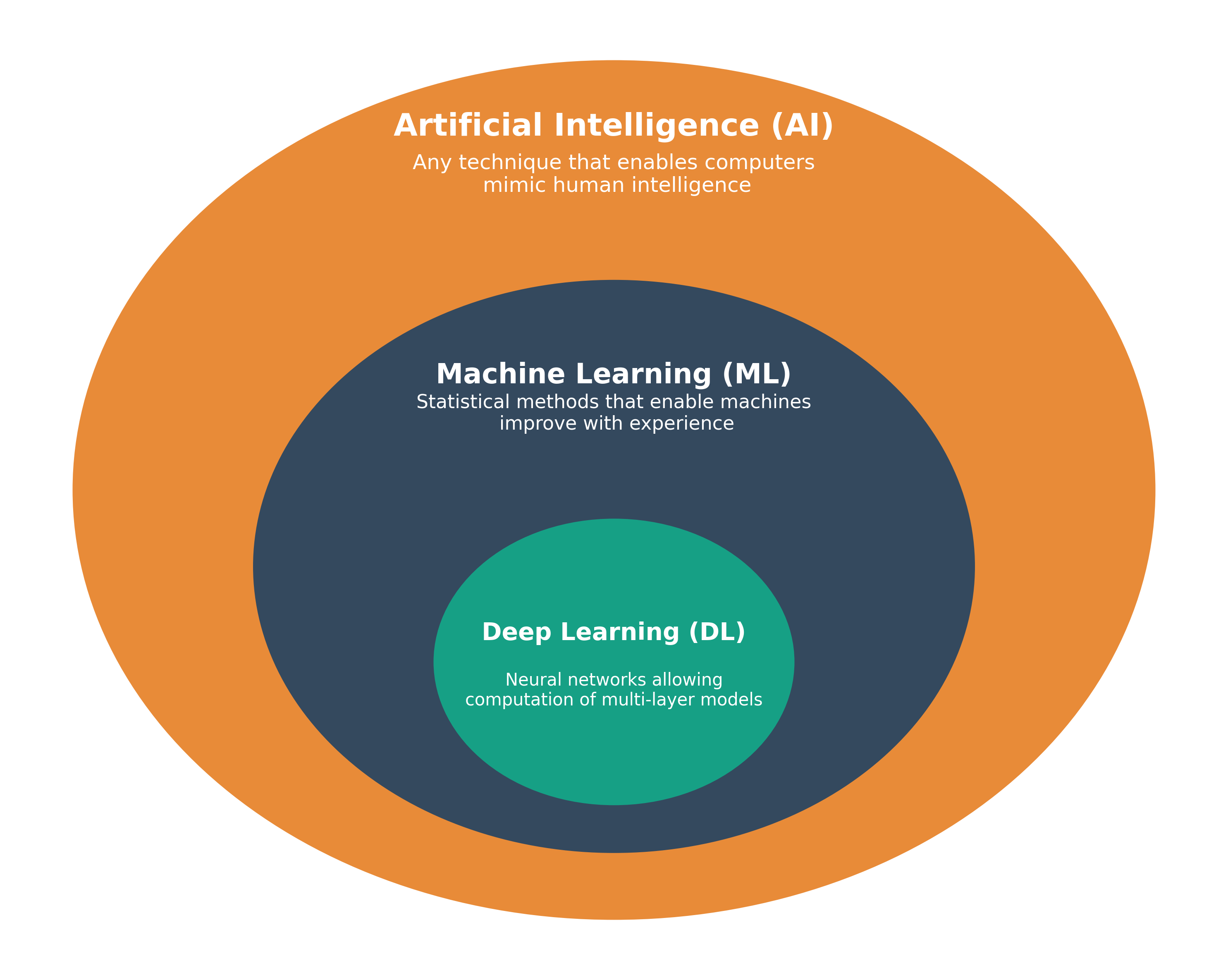
As the name suggests, machine learning is a subset of AI where algorithms are trained to find patterns in data. Instead of being explicitly programmed with rules, the machine learns the rules from the data itself.
For a machine to learn, it typically needs three things:
- Data to learn from.
- A model that can be trained.
- An objective function (or loss function) that measures the model's performance on the data, which the learning algorithm then tries to optimize.
- Diabetes prediction and house price prediction are good examples of machine learning use cases.
- Predictive capabilities in Google Maps, which show you the estimated time to reach your destination, are another example.
Deep Learning (DL)
Deep Learning (DL) is a specialized subfield of machine learning that uses neural networks with many layers (hence, "deep"). These deep architectures allow the model to learn complex patterns and hierarchies directly from the data. The learning process, known as training, involves iteratively adjusting the network's parameters to minimize error, but the defining characteristic is the depth of the neural network.
- Self-driving car systems and image recognition systems are good examples of deep learning.